




State the number of atoms present in each of the following chemical species
(a) CO3-2
(b) PO4-3
(c) P2 O5
(d) CO


(a) CO3-2 – 1+3=4
(b) PO4-3 – 1+4=5
(c) P2O5 – 2+5=7
(d) CO – 1+1=2


Give the chemical formulae for the following compounds and compute the ratio by mass of the combining elements in each one of them. (You may use appendix-III).
(a) Ammonia
(b) Carbon monoxide
(c) Hydrogen chloride
(d) Aluminium fluoride
(e) Magnesium sulphide
S. No. | Compounds | Chemical formula | Ratio by mass of the combining elements |
| (a) | Ammonia | NH3 | N:H=14:3 |
(b) | Carbon monoxide | CO | C:O= 12:16=3:4 |
| (c) | Aluminium fluoride | HCl | H:Cl= 1:35.5 |
(d) | Aluminium fluoride | AlF3 | Al:F=27:57=9:19 |
| (e) | Magnesium sulphide | MgS | Mg:S= 24:32=3:4 |
ABCD is a cyclic quadrilateral (see Fig. 3.7). Find the angles of the cyclic quadrilateral.
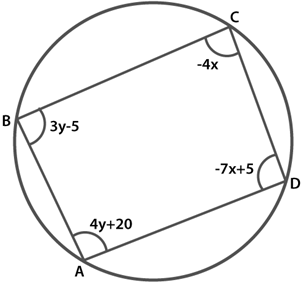
It is known that the sum of the opposite angles of a cyclic quadrilateral is 180o
Thus, we have
C +A = 180
4y + 20- 4x = 180
- 4x + 4y = 160
x - y = - 40 ……………(1)
And, B + D = 180
3y - 5 - 7x + 5 = 180
- 7x + 3y = 180 ………..(2)
Multiplying 3 to equation (1), we get
3x - 3y = - 120 ………(3)
Adding equation (2) to equation (3), we get
- 7x + 3x = 180 – 120
- 4x = 60
x = -15
Substituting this value in equation (i), we get
x - y = - 40
-y-15 = - 40
y = 40-15
= 25
A = 4y + 20 = 20+4(25) = 120°
B = 3y - 5 = - 5+3(25) = 70°
C = - 4x = - 4(- 15) = 60°
D = 5-7x
D= 5- 7(-15) = 110°
Hence, all the angles are measured
Solve the following pair of linear equations:
(i) px + qy = p – q
qx – py = p + q
(ii) ax + by = c
bx + ay = 1 + c
(iii) x/a – y/b = 0
ax + by = a2 + b2
(iv) (a – b)x + (a + b) y = a2 – 2ab – b2
(a + b)(x + y) = a2 + b2
(v) 152x – 378y = – 74
–378x + 152y = – 604
(i) px + qy = p – q……………(i)
qx – py = p + q……………….(ii)
Multiplying p to equation (1) and q to equation (2), we get
p2x + pqy = p2 - pq ………… (iii)
q2x - pqy = pq + q2 ………… (iv)
Adding equation (iii) and equation (iv),we get
p2x + q2 x = p2 + q2
(p2 + q2 ) x = p2 + q2
x = (p2 + q2)/ p2 + q2 = 1
From equation (i), we get
p(1) + qy = p – q
qy = p-q-p
qy = -q
y = -1
(ii) ax + by= c…………………(i)
bx + ay = 1+ c………… ..(ii)
Multiplying a to equation (i) and b to equation (ii), we obtain
a2x + aby = ac ………………… (iii)
b2x + aby = b + bc…………… (iv)
Subtracting equation (iv) from equation (iii),
(a2 – b2) x = ac - bc– b
x = (ac - bc– b)/ (a2 – b2)
x = c(a-b) –b / (a2+b2)
From equation (i), we obtain
ax +by = c
a{c(a-b)-b)/ (a2 – b2)} +by=c
ac(a-b)-ab/ (a2 – b2)+by=c
by=c–ac(a-b)-ab/(a2 – b2)
by=abc – b2 c+ab/a2-b2
y = c(a-b)+a/a2-b2
(iii) x/a – y/b = 0
ax + by = a2 + b2
x/a – y/b = 0
=> bx - ay = 0 ……. (i)
ax + by = a2 + b2 …….. (ii)
Multiplying a and b to equation (i) and (ii) respectively, we get
b2x - aby = 0 …………… (iii)
a2x + aby = a 3 + ab3 …… (iv)
Adding equations (iii) and (iv), we get
b2x + a2x = a 3 + ab2
x (b2 + a2) = a (a2 + b2) x = a
Using equation (i), we get
b(a) - ay = 0
ab - ay = 0
ay = ab,
y = b
(iv) (a – b)x + (a + b) y = a2 – 2ab – b2
(a + b)(x + y) = a2 + b2
(a + b) y + (a – b) x = a2- 2ab - b2 …………… (i)
(x + y)(a + b) = a 2 + b2
(a + b) y + (a + b) x = a2 + b2 ………………… (ii)
Subtracting equation (ii) from equation (i), we get
(a - b) x - (a + b) x = (a 2 - 2ab - b 2) - (a2 + b2)
x(a - b - a - b) = - 2ab - 2b2
- 2bx = - 2b (b + a)
x = b + a
Substituting this value in equation (i), we get
(a + b)(a - b) +y (a + b) = a2- 2ab – b2
a2 - b2 + y(a + b) = a2- 2ab – b2
(a + b) y = - 2ab
y = -2ab/(a+b)
(v) 152x - 378y = - 74
76x - 189y = - 37
x =(189y-137)/76……………..…(i)
- 378x + 152y = - 604
- 189x + 76y = - 302 ………….. (ii)
Using the value of x in equation (ii), we get
-189(189y-37/76)+76y=-302
- (189)2y + 189 × 37 + (76)2 y = - 302 × 76
189 × 37 + 302 × 76 = (189)2 y - (76)2y
6993 + 22952 = (189 - 76) (189 + 76) y
29945 = (113) (265) y
y = 1
Using equation (i), we get
x = (189-37)/76
x = 152/76 = 2
Draw the graphs of the equations 5x – y = 5 and 3x – y = 3. Determine the co-ordinates of the vertices of the triangle formed by these lines and the y axis
Given,
5x – y = 5
=> y = 5x – 5
Its solution table will be.
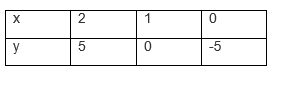
Also given,3x – y = 3
y = 3x – 3
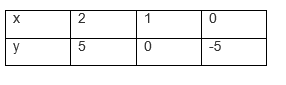
The graphical representation of these lines will be as follows:
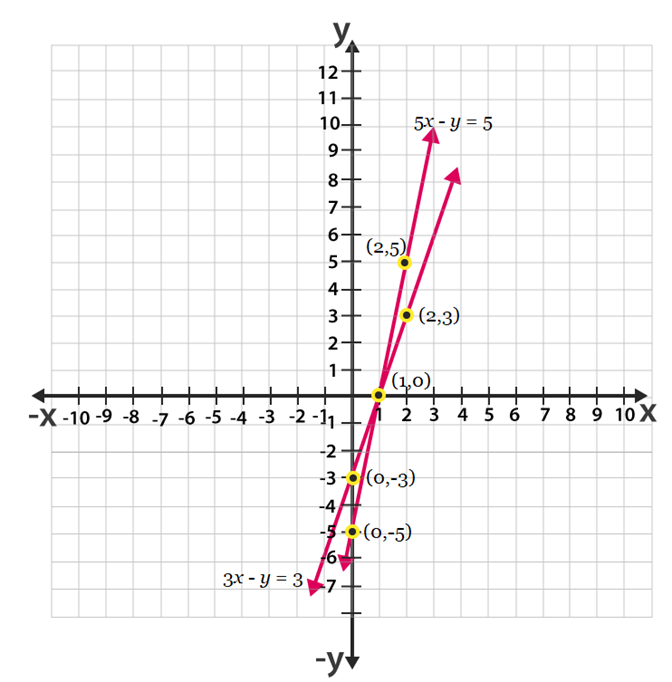
From the above graph we can see that the triangle formed is ?ABC by the lines and the y axis. Also the coordinates of the vertices are A(1,0) , C(0,-5) and B(0,-3).
The students of a class are made to stand in rows. If 3 students are extra in a row, there would be 1 row less. If 3 students are less in a row, there would be 2 rows more. Find the number of students in the class
Let the number of rows be A and the number of students in a row be B.
Total number of students = Number of rows x Number of students in a row
=AB
Using the information, that is given,
First Condition:
Total number of students = (A – 1) ( B + 3)
Or AB = ( A – 1 )(B + 3) = AB – B + 3A – 3
Or 3A – B – 3 = 0
Or 3A – Y = 3 – – – – – – – – – – – – – (1)
Second condition:
Total Number of students = (A + 2 ) ( B – 3 )
Or AB = AB + 2B – 3A – 6
Or 3A – 2B = -6 – – – – – – – – – (2)
When equation (2) is subtracted from (1)
(3A – B) – (3A – 2B) = 3 – (-6)
-B + 2B = 3 + 6B = 9
By using the equation (1) we get,
3A – 9 =3
3A = 9+3 = 12
A = 4
Number of rows, A = 4
Number of students in a row, B = 9
Number of total students in a class = AB = 4 x 9 = 36
A train covered a certain distance at a uniform speed. If the train would have been 10 km/h faster, it would have taken 2 hours less than the scheduled time. And, if the train were slower by 10 km/h; it would have taken 3 hours more than the scheduled time. Find the distance covered by the train.
Let the speed of the train be A km/hr and the time taken by the train to travel a distance be N hours and the distance to travel be X hours.
Speed of the train = Distance travelled by train / Time taken to travel that distance
A = N (distance)/ X (time)
Or, N = AX – – – – – – – – – – – (1)
Using the information that is given, we get:
(A+10) = X/(N-2)
(A + 10) (N – 2) = X
AN + 10N – 2A – 20 = X
By using the equation (1) we get,
– 2A + 10N = 20 – – – – – – – – – – (2)
(A-10) = X/(N+3)
(A – 10) (N + 3) = X
AN – 10N + 3A – 30 = X
By using the equation (1) we get,
3A – 10N = 30 – – – – – – – – – (3)
Adding equation (2) and equation (3) we get,
A = 50
Using the equation (2) we get,
(-2) x (50) + 10N = 20
-100 +10N = 20
=> 10N = 120
N = 12hours
From the equation (1) we get,
Distance travelled by the train, X = AN
= 50 x 12
= 600 km
Hence, the distance covered by the train is 600km.
One says, “Give me a hundred, friend! I shall then become twice as rich as you”. The other replies, “If you give me ten, I shall be six times as rich as you”. Tell me what is the amount of their (respective) capital? [From the Bijaganita of Bhaskara II] [Hint : x + 100 = 2(y – 100), y + 10 = 6(x – 10)].
Let Sangam have Rs A with him and Reuben have Rs B with him.
Using the information that is given we get,
A + 100 = 2(B – 100) ? A + 100 = 2B – 200
Or A – 2B = -300 – – – – – – – (1)
And
6(A – 10) = ( B + 10 )
Or 6A – 60 = B + 10
Or 6A – B = 70 – – – – – – (2)
When equation (2) is multiplied by 2 we get,
12A – 2B = 140 – – – – – – – (3)
When equation (1) is subtracted from equation (3) we get,
11A = 140 + 300
11A = 440
A = 440/11 = 40
Using A =40 in equation (1) we get,
40 – 2B = -300
40 + 300 = 2B
2B = 340
B = 170
Therefore, Sangam had Rs 40 and Reuben had Rs 170 with them.
The ages of two friends Ani and Biju differ by 3 years. Ani’s father Dharam is twice as old as Ani and Biju is twice as old as his sister Cathy. The ages of Cathy and Dharam differ by 30 years. Find the ages of Ani and Biju.
The age difference between Ani and Biju is 3 yrs.
Either Biju is 3 years older than that of Ani or Ani is 3 years older than Biju. From both the cases we find out that Ani’s father’s age is 30 yrs more than that of Cathy’s age.
Let the ages of Ani and Biju be A and B respectively.
Therefore, the age of Dharam = 2 x A = 2A yrs.
And the age of Biju sister Ann B/2 yrs
By using the information that is given,
Case (i)
When Ani is older than that of Biju by 3 yrs then A – B = 3 – – – – – – – – (1)
2A-B/2 = 30
4A – B = 60 – – – – – – – – – – – (2)
By subtracting the equations (1) and (2) we get,
3A = 60 – 3 = 57
A = 57/3 = 19
Therefore, the age of Ani = 19 yrs
And the age of Biju is 19 – 3 = 16 yrs.
Case (ii)
When Biju is older than Ani,
B – A = 3 – – – – – – – – – (1)
2A - B/2 = 30
4A – B = 60 – – – – – – – – – (2)
Adding the equation (1) and (2) we get,
3A = 63
A = 21
Therefore, the age of Ani is 21 yrs
And the age of Biju is 21 + 3 = 24 yrs
Formulate the following problems as a pair of equations, and hence find their solutions:
(i) Ritu can row downstream 20 km in 2 hours, and upstream 4 km in 2 hours. Find her speed of rowing in still water and the speed of the current.
(ii) 2 women and 5 men can together finish an embroidery work in 4 days, while 3 women and 6 men can finish it in 3 days. Find the time taken by 1 woman alone to finish the work, and also that taken by 1 man alone.
(iii) Roohi travels 300 km to her home partly by train and partly by bus. She takes 4 hours if she travels 60 km by train and the remaining by bus. If she travels 100 km by train and the remaining by bus, she takes 10 minutes longer. Find the speed of the train and the bus separately.
(i) Let us consider,
Speed of Ritu in still water = x km/hr
Speed of Stream = y km/hr
Now, speed of Ritu during,
Downstream = x + y km/h
Upstream = x – y km/h
As per the question given,
2(x+y) = 20
Or x + y = 10……………………….(1)
And, 2(x-y) = 4
Or x – y = 2………………………(2)
Adding both the eq.1 and 2, we get,
2x = 12
x = 6
Putting the value of x in eq.1, we get,
y = 4
Therefore,
Speed of Ritu rowing in still water = 6 km/hr
Speed of Stream = 4 km/hr
(ii) Let us consider,
Number of days taken by women to finish the work = x
Number of days taken by men to finish the work = y
Work done by women in one day = 1/x
Work done by women in one day = 1/y
As per the question given,
4(2/x + 5/y) = 1
(2/x + 5/y) = 1/4
And, 3(3/x + 6/y) = 1
(3/x + 6/y) = 1/3
Now, put 1/x=m and 1/y=n, we get,
2m + 5n = 1/4 => 8m + 20n = 1…………………(1)
3m + 6n =1/3 => 9m + 18n = 1………………….(2)
Now, by cross multiplication method, we get here,
m/(20-18) = n/(9-8) = 1/ (180-144)
m/2 = n/1 = 1/36
m/2 = 1/36
m = 1/18
m = 1/x = 1/18
or x = 18
n = 1/y = 1/36
y = 36
Therefore,
Number of days taken by women to finish the work = 18
Number of days taken by men to finish the work = 36.
(iii) Let us consider,
Speed of the train = x km/h
Speed of the bus = y km/h
According to the given question,
60/x + 240/y = 4 …………………(1)
100/x + 200/y = 25/6 …………….(2)
Put 1/x=m and 1/y=n, in the above two equations;
60m + 240n = 4……………………..(3)
100m + 200n = 25/6
600m + 1200n = 25 ………………….(4)
Multiply eq.3 by 10, to get,
600m + 2400n = 40 ……………………(5)
Now, subtract eq.4 from 5, to get,
1200n = 15
n = 15/1200 = 1/80
Substitute the value of n in eq. 3, to get,
60m + 3 = 4
m = 1/60
m = 1/x = 1/60
x = 60
And y = 1/n
y = 80
Therefore,
Speed of the train = 60 km/h
Speed of the bus = 80 km/h
 Science (7568)
 Maths (4467)
 Technology (239)
 English (170)
 Grades