




Find the length of arc and area of the sectors, if the angles subtended at the centre and the radii are 120° and 2.1cm respectively.


l = [angle / 360o] * 2pr p=pie
= [120 / 360] * 2 (22 / 7) * (2.1)
= [0.333] * 13.195
= 4.4cm
Area of the sector = ½ r² angle
= (0.5) * (2.1)2 * (120o)
= 264.6 cm2


From the top of a 50-meter high hill, the angle of depression of the top and the bottom of a tower is 30° and 45°. Find the height of the tower
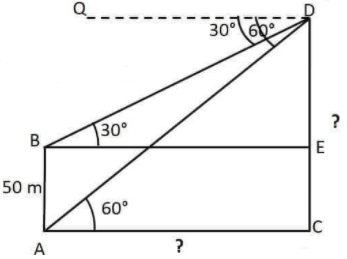
To find the height of the tower CD
Draw BE parallel to AC and DQ.
Lines DQ and BE are parallel, BD is the transversal.
DBE = QDB [alternate angles]
DBE = 30o
Lines DQ and AC are parallel, AD is the transversal.
DAC = QDA [alternate angles]
DAC = 60o
AC and BE are parallel lines.
AC = BE
Similarly, AB and CE are also parallel lines.
CD = AB
CD = 50m
Since DC is perpendicular to AC, ?DEB = ?DCA = 90o.
tan 30o = DE / BE
1 / v3 = DE / BE
BE = v3 DE — (1)
tan 60o = DC / AC
3 = DC / AC
AC = DC / v3 — (2)
From (1) and (2),
v3 DE = DC / v3
DE v3 * v3 = DC
3DE = DC
3DE = DE + EC
3DE – DE = EC
2DE = EC
DE = 50 / 2
DE = 25m
Height of the tower = DC
= DE + EC
= 25 + 50
= 75m
A building is surmounted by a flag, from a point on the ground 20 meters away from the foot of a building, the angle of elevation of the top of the building and flag are 45° and 60°. Find the height of the building and length of the flag.
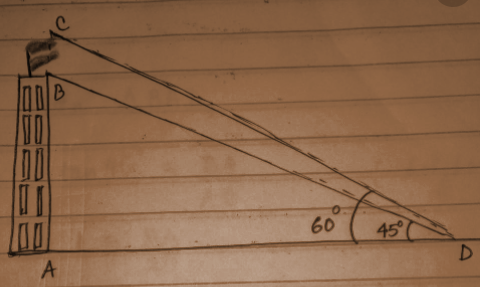
tan 45o = 20 / x
x = 20m = height of the building
tan 60o = h + 20 / x
v3 = h + 20 / 20
h = 20 (v3 - 1)
Height of the flag = 14.28m
Solve the following equation by factorization method:
x2 – [11x / 4] + [15 / 8] = 0
x2 – [11x / 4] + [15 / 8] = 0
8x2 – 22x + 15 / 8 = 0
8x2 – 22x + 15 = 0
8x2 – 12x - 10x + 15 = 0
4x (2x – 3) – 5 (2x – 3) = 0
(2x – 3) (4x – 5) = 0
2x – 3 = 0 Or 4x – 5 = 0
x = 3 / 2 or x = 5 / 4
If a / [y + z] + b / [z + x] + c / [x + y] then prove that a (b – c) / y2 – z2 = b (c – a) / z2 – x2 = c (a – b) / x2 – y2
Let n = a / [y + z] ; n = b / [z + x] ; n = c / [x + y]
y + z = a / n —- (1)
z + x = b / n —- (2)
x + y = c / n —- (3)
(2) – (1)
x – y = [b – a] / n
(a – b) = -n (x – y)
(3) – (2)
y – z = [c – b] / n
(b – c) = -n (y – z)
(1) – (3)
z – x = [a – c] / n
(c – a) = -n (z – x)
Now consider,
a (b – c) / y2 – z2
= a * (-n [y – z] / [y + z] [y – z]
= – na / y + z
= – n * n
= – n2
Similarly,
b (c – a) / z2 – x2
= b * (-n [z – x] / [z + x] [z – x]
= – nb / z + x
= – n * n
= – n2
c (a – b) / x2 – y2
= c * (-n [x – y] / [y + x] [x – y]
= – nc / x + y
= – n * n
= – n2
Therefore,
a (b – c) / y2 – z2 = b (c – a) / z2 – x2 = c (a – b) / x2 – y2
If x = 4ab / [a + b] then prove that [x + 2a] / [x – 2a] + [x + 2b] / [x – 2b] = 2
x = 4ab / a + b
To find [x + 2a] / [x – 2a] + [x + 2b] / [x – 2b]
x = 4ab / [a + b]
x = 2a x 2b / a + b
x / 2a = 2b / a + b
By componendo dividend,
(x + 2a) / (x – 2a) = (2b + a + b) / (2b – a – b)
Simplify RHS.
(x + 2a) / (x – 2a) = (a + 3b) / (b – a)
Similarly (x + 2b) / (x – 2b) = (3a + b) / (a – b)
(x + 2a) / (x – 2a) + (x + 2b) / (x – 2b)
= (a + 3b) / (b – a) + (3a + b) / (a – b)
= (a + 3b) / (b – a) – (3a + b) / (a – b)
= a + 3b – 3a – b / b – a
= 2b – 2a / b – a
= 2 (b – a) / b – a
= 2
Solve for x and y the system of equations
x+ ay = b
ax – by = c
x + ay =b …. (i)
ax – by = c ….(ii)
Multiply equation (i) by a,
ax + a2y = ab …. (iii)
Subtracting equation (ii) from equation (iii),
a2y + by = ab – c
y = [ab – c] / [a2 + b]
Put the value of y in the equation (i),
x = b – ay
x = b – a {[ab – c] / [a2 + b]}
= [b2 + ac] / [a2 + b]
By adding 5 to the denominator and subtracting 5 from its numerator 1 / 7 is obtained. If 4 is subtracted from its numerator then 1 / 3 is obtained. Find that number.
Let the numerator be = x
Let the denominator be = y
Therefore, the fraction is = x / y.
Given that,
(x – 5) / (y + 5) = 1 / 7
(7) (x – 5) = (1) (y + 5)
7x – 35 = y + 5
7x – y = 35 + 5
7x – y = 40 —- (1)
(x – 4) / (y) = 1 / 3
(3)(x – 4) = y
(3x – 12) = y
3x – y = 12 —- (2)
3 * (7x – y = 40)
7 * (3x – y = 12)
21x – 3y = 120 —- (3)
21x – 7y = 84 —-(4)
4y = 36
y = 36 / 4
y = 9
Put y = 9 in (1),
7x – y = 40
7x – 9 = 40
7x = 40 + 9
7x = 49
x = 49 / 7
x = 7
Thus the fraction is 7 / 9.
Solve the following system of equations by substitution method.
3x + 2y = 14
-x + 4y = 7
3x + 2y = 14 —- (1)
-x + 4y = 7 —- (2)
Multiply equation (2) by 3,
-3x + 12y = 21 —- (3)
3x + 2y = 14 —- (1)
-3x + 12y = 21 —- (3)
14y = 35
y = 35 / 14
y = 5 / 2
Put y = 5 / 2 in (1),
3x + 2 * (5 / 2) = 14
3x + 5 = 14
3x = 9
x = 3
Find the probability that a leap year, selected randomly, will contain 53 Thursdays.
There are 366 days in a leap year.
52 weeks + 2 days.
These 2 days can be:
(a) Monday, Tuesday
(b) Tuesday, Wednesday,
(c) Wednesday, Thursday
(d) Thursday, Friday
(e) Friday, Saturday
(f) Saturday, Sunday
(g) Sunday, Monday.
Let A be the event that a leap year contains 53 Thursdays.
n (A) = {Wednesday, Thursday},{Thursday, Friday}}.
= 2
Required probability p (A) = n (A) / n (S)
= 2 / 7
 Science (7568)
 Maths (4467)
 Technology (239)
 English (170)
 Grades